

AMC has been performed ten thousand knifeless surgeries
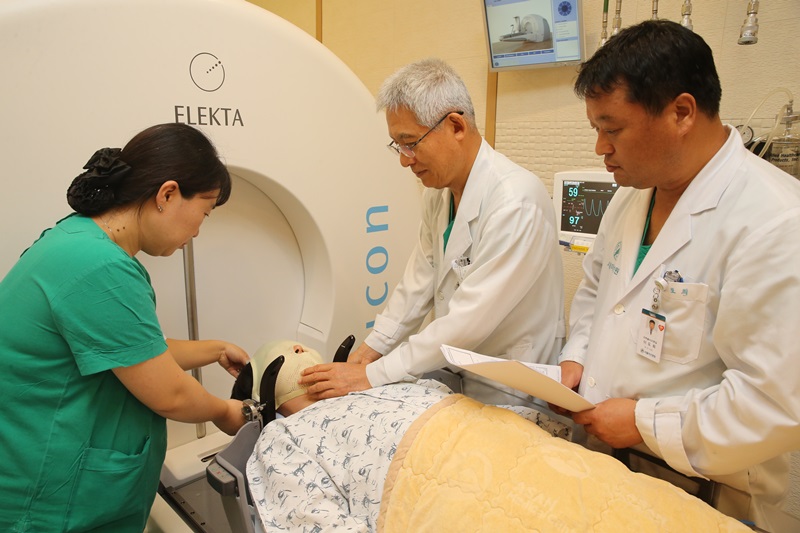
The photo shows Prof. Kwon Do-hoon of the Department of Radiology (second from the right) explaining his surgery plan to a brain disease patient prior to Gamma Knife surgery while putting a mask on the patient.
On May 7, 1990, AMC performed the first Gamma Knife surgery in Korea. It involved the accurate location of a lesion inside the brain using a 3-D coordinate system without opening the head and the precise application of radiation to the area surrounding the lesion away from brain tissue, a new and innovative treatment in those days. Since then, AMC has performed 8,936 Gamma Knife surgeries while phasing in cutting-edge medical equipment to enhance surgical performance. The CyberKnife system, a noninvasive treatment using image-guided technology to track the location of a tumor, was also introduced in June 2011 and has been performed 1,064 times to this day. In total, 10,000 brain stereotactic radiosurgeries have been performed, including Gamma Knife and CyberKnife surgeries, since the first operation 27 years ago.
Ten thousand brain stereotactic radiosurgeries have been performed for over 27 years
Since their introduction in AMC, 8,936 Gamma Knife surgeries and 1,064 CyberKnife surgeries have been performed in the center.
How do you treat brain diseases such as brain tumors? You may think of craniotomy—opening the skull to remove a lesion. But in many cases, brain stereotactic radiosurgery without the need of general anesthesia or scalp dissection is more useful depending on the location and size of a tumor and patient conditions.
Brain stereotactic radiosurgery is a noninvasive treatment that accurately locates a lesion inside the brain using a 3-D coordinate system and intensively applies high-dose irradiation to the tumor away from brain tissue. It can be adopted when lesions are located in difficult-to-access regions or when patient conditions are too severe for an operation. Moreover, the treatment works quite well, so it is used to treat diverse kinds of brain diseases, such as cerebral arteriovenous malformations; metastatic brain tumors; intracranial meningioma; trigeminal neuralgia, which does not respond to medications; and hand tremors.
AMC’s Radiation Surgery Center recently performed its 10,000th brain stereotactic radiosurgery, a record made 27 years since the first Gamma Knife surgery on a patient with a cerebral arteriovenous malformation in Korea on May 1990. Less than 10 hospitals worldwide have experience in more than 10,000 brain stereotactic radiosurgeries, such as the United States, France, Japan, and China.
Brain stereotactic radiosurgery is divided into Gamma Knife surgery and CyberKnife surgery, according to therapy equipment. The Radiation Surgery Center has performed 8,936 Gamma Knife surgeries and 1,064 CyberKnife surgeries on brain disease patients, with about 90% and 95% success rates in malignant brain tumors and benign brain tumors, respectively. Gamma Knife surgery is designed to treat tumors or vascular malformations by accurately irradiating gamma rays to the tumor site. At AMC, 3,804 patients with malignant brain tumors, including metastatic brain tumors (42.6%); 2,978 patients with benign brain tumors, including intracranial meningioma and acoustic tumors (33.3%); 1,786 patients with cerebrovascular diseases, including cerebral arteriovenous malformations (20%); and 368 patients with trigeminal neuralgia and epilepsy (4.1%) were treated with Gamma Knife surgery.
The record of performing 8,936 Gamma Knife surgeries for brain diseases is more meaningful in that around 3,000 Gamma Knife surgeries were performed in five years, a relatively short period after 6,000 Gamma Knife surgeries had been performed by 2012 since its introduction in 1990. AMC’s Gamma Knife surgeries have very high success rates of about 90% in malignant brain tumors and about 95% in benign brain tumors.
AMC first introduced the Gamma Knife system in Asia in 1990. Since 2011, when cutting-edge Gamma Knife Perfexion was also introduced, AMC was able to provide more precise treatment and significantly cut the time for treatment through the automation of the whole operation process. Moreover, AMC has recently introduced Gamma Knife Icon, an upgraded version of Gamma Knife Perfexion, to enhance patient convenience by allowing patients to put on face masks for surgery instead of surgical frames that fix the patients’ heads tightly.
The CyberKnife system is a cutting-edge radiotherapy technology that applies radiation with movable robotic arms while tracking the location of a lesion using image-guided technology. At AMC, 1,064 patients with brain diseases, 425 patients with metastatic brain tumors (40%), and 639 patients with benign tumors, including intracranial meningioma, Pituitary adenoma, and acoustic tumors, were treated with CyberKnife surgery.
The Radiation Surgery Center reported that AMC’s CyberKnife surgery was also very successful, with high success rates of about 90% in metastatic brain tumors and about 95% in benign brain tumors. CyberKnife surgery can be used all over the body, including the chest, abdomen, and spine other than the brain, head, and neck since this approach accurately irradiates the tumor by tracking its slightly changing location because of the patient’s movement or breathing in real time. AMC uses the CyberKnife system even in surgery for tumors developed in the spine, lungs, and prostate.
Radiation Surgery Center Director Roh Sung-woo said, “Both Gamma Knife and CyberKnife surgeries are the most used in surgery for metastatic brain tumor. It’s because many divisions, including neurosurgery, oncology, and radiation oncology, collaborated to obtain the best results in treating metastatic brain tumor. The Radiation Surgery Center is committed to improving patient convenience and offering fast and comfortable treatment through a same-day surgery system, requiring no hospital stay or waiting.”
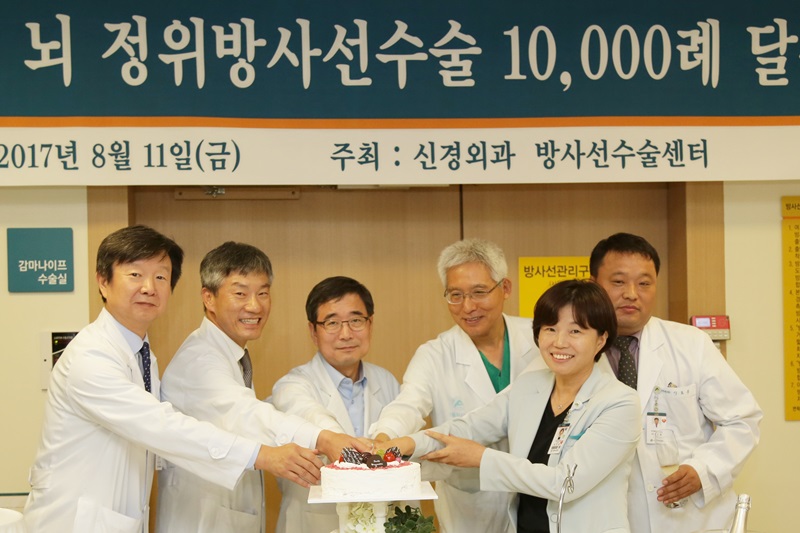
In the photo, at the ceremony to celebrate the performance of 10,000 brain stereotactic radiosurgeries held at the Gamma Knife Center (2F, East Building) on August 11, Vice President and Chief Education Officer Kim Jae-joong, director of Clinical Support Park Seung-il, Prof. Kim Sang-we of the Department of Oncology, Prof. Kwon Do-hoon of the Department of Neurosurgery, Unit Manager of Outpatient Nursing Team I Choi Han-joo, and Special Scholar Lee Do-hee at the Office for Medical Physics Support (from the left) cut a celebration cake.