

American Patient with Liver Cirrhosis Gains a New Life After LDLT at AMC
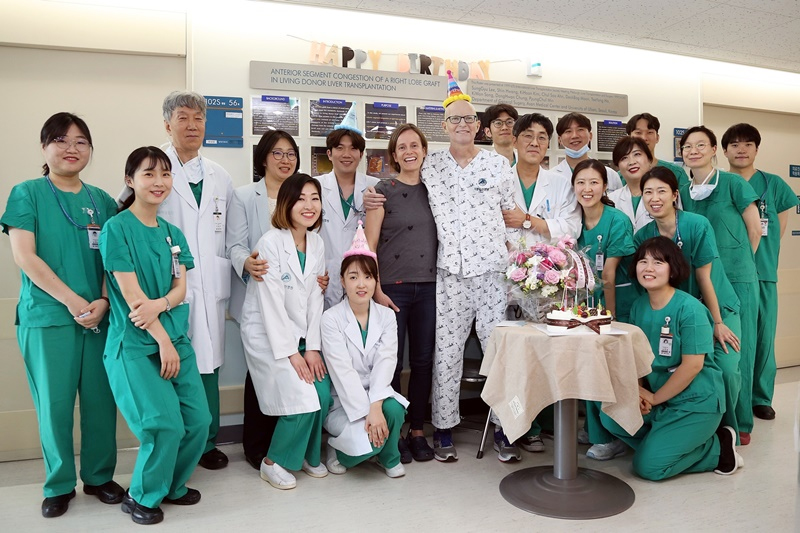
Mr. Carlson, the American patient who underwent a LDLT at AMC, had a birthday celebration in Ward 102S on February 22 this year. Mr. and Mrs. Carlson in cone caps with their arms around each other’s shoulders are in the photo with AMC’s liver transplantation team members including, Chair Professor Lee Sung-Gyu (third from left) and Professor of Song Gi-Won of the Department of Liver Transplantation and Hepatobiliary Surgery(left to the patient).
A patient with liver cirrhosis who was treated at the Stanford University Medical Center in the United States received a living-donor liver transplantation (LDLT) at AMC and fully regained health in two months. Charles Carlson (male, 47) was diagnosed with liver cirrhosis and myelodysplastic syndrome in 2011.
Myelodysplastic syndrome (MDS) is a disease that causes symptoms such as immunological abnormalities, infections, and bleeding due to poorly formed cells. Despite chemotherapy for MDS, his condition only worsened. As a last resort, he was put on the liver transplant waiting list. However, his health was deteriorating over time. The only way to treat his illness was a LDLT, but it uncertain whether he would fully recover after the LDLT. Therefore, all hospitals in the United States were reluctant to perform the LDLT on him. Finally, Stanford Medical Center’s specialists recommended him to undergo surgery at AMC, for Korea has more advanced medical skills in LDLT than the United States. They personally sent an email to Professor Song Gi-Won of the Division of Liver Transplantation and Hepatobiliary Surgery to ask for a treatment avenue.
Mr. Carlson visited AMC in November last year and underwent the LDLT on December 19. AMC’s liver transplantation team removed 62% of his wife’s liver and transplanted it to him. It was a very complicated surgery, as he had many collateral vessels, such as portal vein thrombosis, and a severe adhesion due to the repeated peritonitis caused by liver cirrhosis. The surgery took about 18 hours and required massive transfusion with 16 packs of platelets and 20 packs of blood.
After two months in the ICU, he was transferred to a general ward in the middle of February this year. He was discharged from the hospital on February 25, 2019, and he returned home. He will be followed up for a year while receiving chemotherapy for MDS at the Stanford University Medical Center and will undergo bone-marrow transplantation again later. Mr. Carlson said, “Thanks to all the staff’s efforts and care, I could regain my health without any discomfort. I would like to thank AMC for making me live a normal, happy life with my family again.”
“I could not say for sure that the liver transplantation would be successful because of the patient’s health condition, but everyone in our team shared his condition every day and worked together to make it successful,” said Professor of Song Gi-Won of the Division of Liver Transplantation and Hepatobiliary Surgery.
“It was very inspiring that Stanford University Medical Center, one of the ten leading hospitals in the United States, recognized the excellence of our medical skills and trusted us with him. We will continue working hard and researching to benefit such patients from all over the world,” said Chair Professor Lee Sung-Gyu of the Division of Liver Transplantation and Hepatobiliary Surgery.