

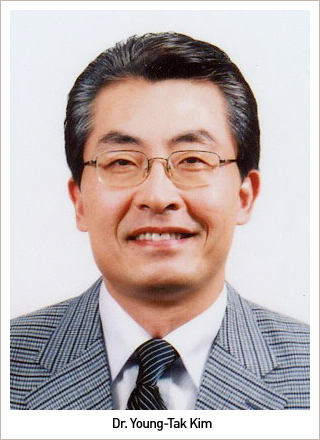
AMC Dr. Young-Tak Kim, professor of the department of obstetrics and gynecology, interviews that 70~80% of patients have no symptom of uterine fibroids
AMC Dr. Young-Tak Kim, professor of the department of obstetrics
and gynecology, interviews that 70~80% of patients have no symptom
of uterine fibroids
Taking it as a potbelly and leaving it untreated
Source: Joongang Ilbo �� Bae Ji-young
Lately American actress Angelina Jolie has undergone mastectomy and revealed her plan to get her uterus
removed as well, which is probably due to the fear for multiple myoma. Uterine fibroids are a very common
tumor that develops in 2-3 out of ten women in their twenties and 4 out of ten women in their forties. Recent
development of diagnostic imaging devices further increases the rate of diagnosis. Dr. Young-Tak Kim of the
department of obstetrics and gynecology of Asan Medical Center (AMC) talked about the causes and treatments
of uterine fibroids.
Q. There are more patients with uterus myoma than expected. Almost one in every four women is
dignosed with uterus myoma. What causes it?
�쏹nfortunately we do not know what exactly causes uterine fibroids. Endometriosis is often related to taking greasy
foods, while cervical cancer is usually linked with sex life and virus infection. However, many studies found
no connection between a uterine myoma and dietary habit, lifestyle, or virus infection. Only female hormone is
known to be involved. Evidence shows that inhibiting the release of female hormone led to reduction in size of
a myoma.��
Q. What are the symptoms?
�쏶ymptoms vary depending on the location of a myoma in the uterus. Myoma within the uterus causes bleeding
and severe pain, but myoma in the outer portion of the uterus may show no symptom at all. 70-80 percent of
patients experience no symptoms. Many take it as a potbelly as the size of their stomach gradually grows.
Big myoma can block blood from being flown into the central part, so it can just necrotize, which triggers pain.
Also, a cluster of many small myomas causes bleeding, which may lead to anemia.��
Q. Should a myoma be removed?
�쏯o. Since it is similar to a lump on face, there is no need to remove it unless it does not bother you or develops
into cancer. If a uterine myoma does not cause any symptoms and is small in size, it is okay not to remove it.
The myoma grown bigger than 5-6 centimeters will press the bladder or intestine, making you urinate frequently
and suffer from dyschezia. Bleeding that occurs depending on the site of the tumor will lead to serious anemia
as well. If such symptoms appear or the myoma grows large enough to cause discomfort, it is eliminated.
However, if a patient does not feel uncomfortable even with the myoma in size over 10 centimeters, it is unnecessary
to remove it. Therefore, it is recommended to regularly monitor the development of the myoma to avoid a bulge
in the abdomen and necrosis.��
Q. Is there any treatment available?
�쏷here are many ways to remove a myoma. The classical method is to cut the patient�셲 stomach and the uterus
open to eliminate the tumor. This method has advantages of clearly seeing the location of the myoma and precisely
closing the site. Another method is a laparoscopic surgery. This is to make two or three small openings in the
abdomen and insert an endoscope or surgical instrument through them to remove or break up the myoma.
It leaves small scar and lessens the risk of adhesion. It also causes less post-operative pain and shortens
the hospitalization period up to two to four days, which is about one week shorter than that of an abdominal
section. In case of the abdominal section, it usually takes two to three weeks until a patient can get back to work,
but laparoscopic operation requires much less time. However, this therapy is not available for every patient.
If the tumor is too big or located in a difficult place to be accessed by a laparoscope, abdominal section is the
better option. As for women of childbearing age, the surgical site may tear when delivering. For this reason,
abdominal section is recommended.��
Q. What about an embolization procedure?
�쏷his treatment blocks blood vessels to prevent blood from flowing into the myoma, which will naturally shrink
the size of tumor. This method causes the least damage to the uterus since it does not make holes in the abdomen
nor open up the womb. The weakness of this treatment is that the myoma is not completely eliminated and its
size reduces merely by 20-30%. Moreover, the tumor tends to shrink slowly, so it takes months to have the desired
effect. There is another therapy �� myolysis, which necrotizes the myoma using high temperature close to 100�꼦.
It also has an advantage of causing less damage to the uterus. It shrinks the size of the tumor by 50~60%,
which is more effective than the embolization procedure. Even though this therapy is known to be quite safe
and effective, it is reported to affect the bladder or small intestine. Therefore, it is recommended to seek an
experienced surgeon to have this treatment.��
Q. What about the method to have the uterus removed?
�쏷here are some patients who experience the reoccurrence of this disease even after removing a myoma.
Also, the recurrence rate is usually 20~40%. Multiple myomas are more likely to recur. For these patients,
removing the womb itself may be better than undergoing repeated operations. In addition, patients who have
several myomas which cause too much bleeding and patients whose myoma is likely to develop into a cancerous
tumor need to undergo a total hysterectomy. Women without the possibility of conceiving tend to choose this
therapy. Many are anxious that this therapy may affect the body, but numerous clinical trials revealed no significant
changes in health conditions. Sexual life also tends to be influenced not by the removal of the uterus but by
psychological effect.��
Q. Is it connected with fertility?
�쏛 woman with uterine fibroids may be unable to conceive, but it depends on where the myoma is located.
If the tumor is located in the inner membrane of the womb where an embryo is implanted, implantation itself
may be difficult. If the tumor is in a position that does not influence on implantation, she has no trouble of being
pregnant. However, a patient has to be careful even after having her myoma removed. If the surgical site is under
the lining of womb, the scar may impede implantation. Moreover, the site will be become thinner which may cause
it to rip open during delivery. Therefore, it is recommended to consult a doctor about this matter.��
Q. How can uterine fibroids be prevented? Is there any examination method?
�쏷here is no clear cause of uterine fibroids, so it is difficult to prevent it. Rather, it is more important to carefully
monitor the condition of a myoma after discovering it. First, after the discovery of the myoma, it is essential to
observe the size of the tumor on a basis of six months to one year to see if it develops into a cancerous tumor
or if its growth is rapid. It can be detected by an ultrasound scan. According to statistics, less than 1% of myoma
develops into a cancer, which is an uncommon case. There are many causes for the rapid growth of a myoma,
so constant monitoring is the best way to prevent it.��
Q. What about the use of oriental medicine?
�쏧 have no idea how oriental medicine works to treat uterine fibroids. I have seen some patients whose myoma
reduced in size after taking oriental medicine, but this is a very rare case for patients whose tumor became larger
were also witnessed. Western medicine can also reduce the size of the myoma. There is a drug that blocks
the release of female hormone to decrease the size of the myoma. If it is too big, a surgical method can be
applied after reducing its size using the drug.��