

The Challenger Opening the New Vistas for Patient Pain Treatment - AMC Dr. Jin Woo Shin, Associate Professor of the Department of Anesthesiology and Pain Medicine
The Challenger Opening the New Vistas for Patient Pain Treatment
- AMC Dr. Jin Woo Shin, Associate Professor of the Department of
Anesthesiology and Pain Medicine
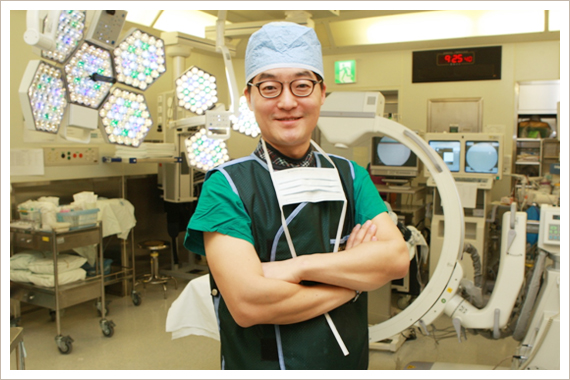
No matter how great his idea was, it had been fruitless due to his hesitation. He was a quiet and a shy boy.
One day, his teacher recognized his brilliance and suggested him to run for the class president. Even though
it was his first challenge, it was a challenge that changed his life entirely. He had no other dream but becoming
a doctor. He did not wander off because he had a clear goal of becoming a doctor, but came to an unexpected
hesitation over the decision of his major. After circulating every department, he chose the department of
anesthesiology and pain medicine. Almost all patients suffer from pain. This was his second challenge.
A small thing makes a difference.
The role of Dr. Jin Woo Shin of the Department of Anesthesiology and Pain Medicine is to treat pain that remains
even after the cause of disease is eliminated, and that pain is now not simply a symptom but a disease. In 2003,
one line was added to his career. He developed a catheter (tube) to be used for lumbar spinal stenosis, first
in the world. One day a junior surgeon asked to him when leaving the surgical room after a lumber spinal stenosis
surgery.
�쏧f you have a good idea, why don�셳 you develop one?�� He also felt the limit of existing treatment method.
�쁗hat about applying a balloon which has been used in treating angiostenosis to this surgery?�� First, he had to
prove that the balloon-based method is as safe and effective as the existing surgical method. He inserted a very
tiny latex balloon into the narrowed spinal foramen of a patient with lumbar spinal stenosis. Its effect was amazing.
He checked the degree of inflation using contrast medium and found that the diameter and volume of the inflated
space increased up to 28% and 98%, respectively. �쏧 became better and now walk well.�� Such delightful voice
of patients cheered him up.
There was also a failure. The catheter grew thicker as the hole for drug injection, the hole for balloon, and the
up-down-left-right moving function were combined. He made pilot products repeatedly, and underwent trial and error.
He thought of patients whenever he wanted to give up due to the gap between idea and reality. In the end, the
2-year long challenge was not fruitless. The result was astonishing. Patient�셲 pain reduced by 50% and walking
distance improved by three times. As the drug can be injected into the exact site, the risk of complications
had been reduced. The paper summarizing the results of treatment was published in the international journal
�똏ain Physician��, receiving attention from the academia.
Since the surgical method was approved as a new medical technology with proven safety and efficacy by the
Ministry of Health and Welfare last August, a growing number of hospitals started to line up to learn the method.
The new catheter is currently being prepared to apply for FDA approval for export. It will not be long before medical
professionals around the world would use Korean technology to treat pain. �쏶o far keeping up with the most popular
surgical method was considered the best way to treat patients. However, now is the time to take the lead. It is
a very realistic possibility.�� Undaunted challenges make it possible to take a big step forward.
Believing the existence of patient�셲 pain is the beginning of treatment
Pain is an invisible disease, so it is easy even for family members to ignore the pain. �쏧t must have hurt you a lot.��
Hearty consoling words would move the hearts of ill patients to tears. There is a lesson here. Treating pain starts
by listening to and believing in what patients are complaining of. They say that he always approaches with a smile
when speaking to them. That is why he looks comfortable rather than authoritative.
�쏦e always greets patients with a smile and encourages them.�� Outpatient nurses are saying that his patients are
beginning to resemble the facial expression of Dr. Shin. What Dr. Shin says most often is this: I will do my best,
so you will be better soon. This encourages patients and helps them not to give up their hope.
There was time when we remained helpless when patients complained of pain because it was considered just
a signal of body that there is something wrong. It was just 20 years ago. There is only a very slight difference
between what was familiar and what is new. �쏧f we do not challenge, we will not have these achievements.��
He learned a great lesson from the challenge from the past three years. �쏻hat is important is that I never give up.
Thus, I can challenge again.�� Dr. Shin�셲 new challenge will be the new beginning.